How Fuses Work
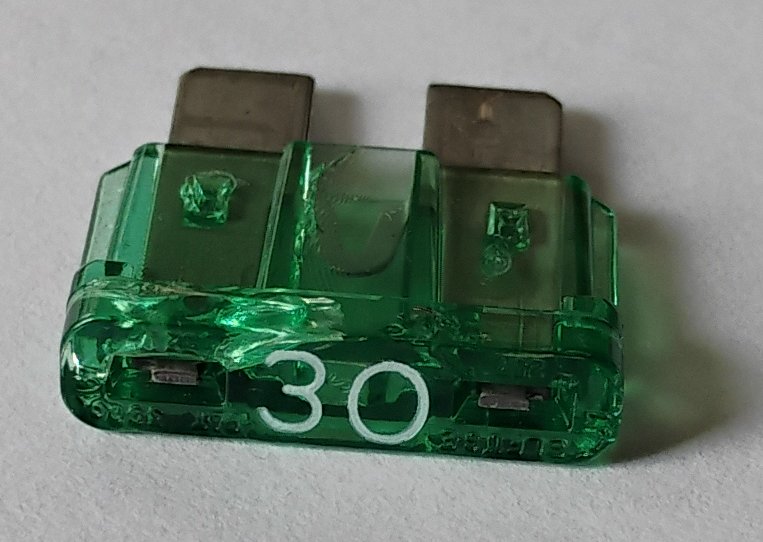
A fuse is an electrical device which interrupts a circuit during an overload condition. It is usually a thin piece of wire in some kind of a holder. When the current passing through it exceeds the intended limit, the wire starts to heat up and, if the overload is large or sustained, melt. Often this wire or metal strip is made of a special alloy which melts at a relatively low temperature.
A fuse has two key ratings. The first is a current in amperes. The second is a voltage. The meaning of the current rating is easy to understand. At some point above this current the fuse will “blow.” But the voltage rating is a frequent subject of confusion. This is one of those cases where a little bit of knowledge is dangerous. While the average person looks only at the amperage rating, someone who has had a little education in electrical theory may attempt to apply Joule’s law:
Watts = Volts x Amperes
Let’s say we have a 12-volt automotive circuit protected by a 10 amp fuse:
12 volts x 10 amperes = 120 watts
So a fuse which blows at 10 amps blows at 120 watts. But what if we put it in a six volt circuit? Since energy is what melts the fuse and energy delivery is measured in watts, it might seem that we should compute the current for 120 watts at six volts:
  120 watts
-------------- = 20 amperes
   6 volts
The math seems clear: a 12 volt fuse in a six volt circuit can be expected to carry twice its rated current.
I have encountered this reasoning repeatedly online. For example, there is an excellent video entitled Bad Fuses on the Youtube channel Ham Radio A2Z. In it inexpensive automotive fuses bought from a major online retailer are tested. It is found that what is ostensibly a five amp fuse will carry 21 amperes indefinitely. This is totally unaccepable.
However a number of viewers suggested the test was invalid because the meter on the test rig showed 0.6 volts applied to the fuse. This is one such comment:
Do you think the issue with the 5 amp fuse not blowing, may have be due low voltage used in the test. 0.6 volts (0.6 volts x 21 amps = 12.6 watts). Did you try the same fuse at 13.8 volts (13.8 volts x 21 amps = 289.9 watts).
While the mathmatical calculations are performed correctly, the application of Joule’s law is erroneous. To understand why, let’s look at a simple circuit protected by a fuse.
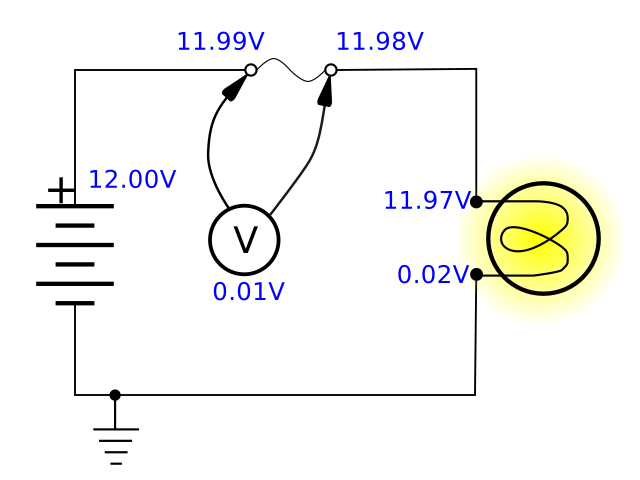
Notice that the fuse is not connected to the load in parallel, as if it were a second lamp. Instead it is a short segment of the conductor leading to the electric lamp which serves as the load.
Since it is connected in series with the load, a fuse is not exposed to the system voltage during normal operation. (In much the same way as a bird perched on a high-voltage wire is not exposed to the voltage since it is not also touching the ground.) Until the fuse blows, the voltage measured between its terminals will be only a fraction of a volt.
During an overload, this voltage will be higher, but at two, three, or ten times the rated current, the voltage will be two, three, or ten times that tiny faction. It is this tiny voltage multiplied by the current which gives us the power in watts which will potentially melt the fuse. If instead we were to try to computing the power by multiply 12 volts by the current, we could actually be computing the power consumed by the lamp, which is irrelevant to the fuse.
When the fuse blows the system current drops to zero and the voltage across the terminals of the fuse rises to the full system voltage, as illustrated below:
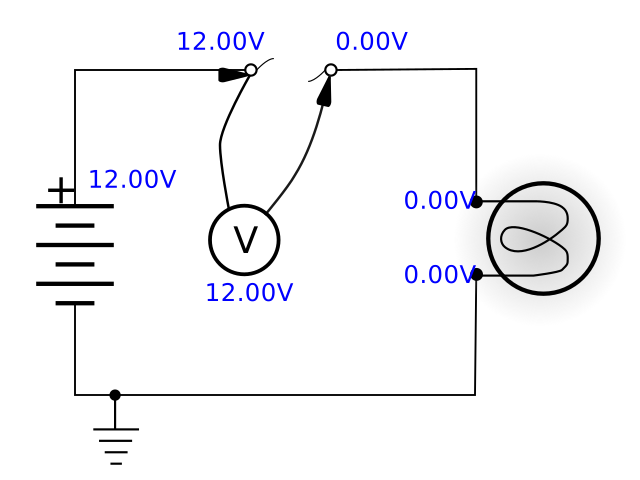
It is at this moment that the voltage rating of the fuse becomes importing. If the gap created by the melting of the fuse is too small, then the current may arc across the gap, particularly in a DC system. Higher voltages can jump larger gaps. The voltage rating of a fuse describe its ability to prevent this, often simply by making the gap larger.
In conclusion, the voltage and current ratings of a fuse are independent. One should not attempt to adjust the current rating using Joule’s law. Choose a fuse with a voltage rating above the voltage of the power supply. Choose a current rating a bit above the maximum expected during normal operation. And choose conductors which can safely carry that current.