Every Sound Dies
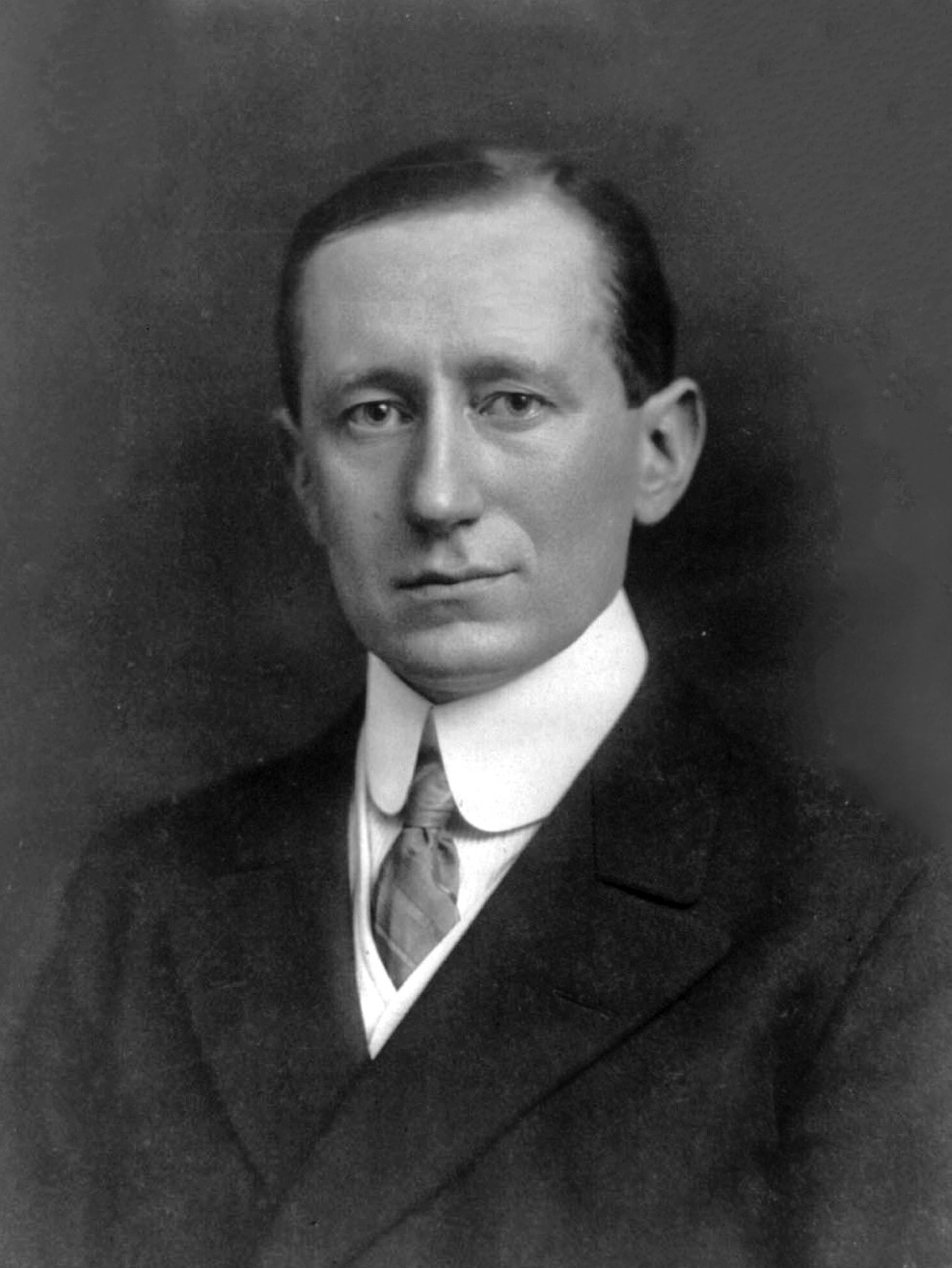
Since my previous article on Marconi I have tracked down the source of the extraordinary assertion made in the Provincetown Independent that the radio pioneer believed “sound never disappears from Earth”.i All the references I have found to this idea eventually lead back to the book Perfecting Sound Forever: An Aural History of Recorded Music by Greg Milner which was published in 2009ii. The story is not part of the main body of the book. Instead it is part of a teaser essay. This is what he wrote:
The story goes that, late in his life, Guglielmo Marconi had an epiphany. The godfather of radio technology decided that no sound ever dies. It just decays beyond the point that we can detect it with our ears. Any sound was forever recoverable, he believed, with the right device. His dream was to build one powerful enough to pick up Christ’s Sermon on the Mount.
The phrase “the story goes” is the usual way to introduce an anecdote one suspects is apocryphal but intends to use anyway for rhetorical purposes. Later in the essay he makes its fabulous nature a bit more explicit:
Raw sound may not have much of a shelf life, but Marconi’s theory surely does. It survives as a low-level urban legend, bandied about in dorm rooms and Internet forums. I thought it was true before I even knew who Marconi was, and I have no idea where I learned it. Maybe you’ve always believed it, too. Its survival attests to a universal desire and anxiety. Our time on Earth is fleeting, the impressions we leave on it are ephemeral, but maybe there is a part of us that can outlast this dust-to-dust. Maybe our complete history is all around us. We just need to learn how to read it.
I have searched extensively online for evidence of other sources of the story, but have found nothing. Other tellings I found refer explicitly to this book, quote the first paragraph of the essay, or are based on an enhanced version written by podcaster Nate DiMeo.
DiMeo wrote in the notes to the June 1, 2009 episode of the Memory Palace podcast which is entitled These Words, Foreveriii that he was “spurred into doing it for the podcast after flipping through David (sic) Milner’s book Perfecting Sound Forever”. It is a three-minute story. After introducing Marconi and talking about his worldwide fame DiMeo says:
But we are told that in his 60’s, somewhere around the time of his fourth or fifth heart attack, the inventor began to think about mortality. Or rather he began to think about immortality. Marconi become convinced that sound never dies, that sound waves once emitted from a radio from the vibrating strings of a Stradivarius, from whispering lovers, from a baby discovering how to make a “bah” or “guh” sound for the first time. Sound lived on forever, its waves flowing permanently, but growing weaker and weaker with each moment. He just hadn’t built a radio powerful enough to tune in the signal.
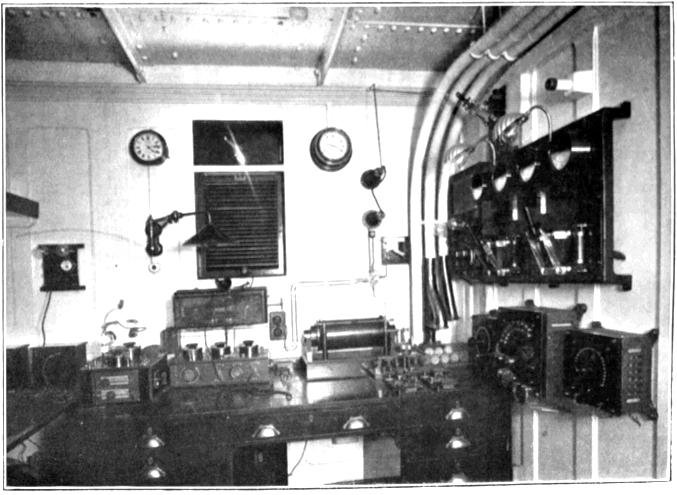
Now this is wrong, but it wasn’t entirely foolish. One of the things that had made Marconi so famous was the sinking of the Titanic. Seven hundred and six people were rescued from the icy water after radiomen on nearby ships heard its distress signal. Newspapers around the world credited Marconi as their savior. Now, one of those radiomen, working the night shift on a Russian steamer, heard the signal through his headphones more than an hour-and-a-half after it was sent. This was just a physical anomaly, atmospheric conditions or whatnot.
But here was Marconi near the end of his life growing weaker and weaker with each heart attack, dreaming of a device that would let him hear lost sounds, let him tap into these eternal frequencies. He would tell people that if he got it right, he could hear Jesus of Nazareth giving the Sermon on the Mount. But he would be able to everything ever said, everything he ever said. At the end of his life he could sit in his piazza in Rome, and hear everything that was ever said to him or about him. He could relive every toast and testimonial. And we all could – hear everything: Hear Caesar, Hear Shakespeare give an actor a line-reading, hear my grandmother introduce herself to my grandfather at a nightclub in Rhode Island, hear someone tell you that they love you, that first time they told you they loved you, hear everything, forever.
Ten years before his death Marconi did suffer a heart attack followed by angina pectoris and his heart problems eventually killed him.iv But the rest of this expanded version of the story appears to be nothing more than the podcaster’s own musings on the urban legend from Milner’s book. He supposes, but does not tell us that he is just supposing, that Marconi, as his death approached, would have been keen to hear sounds from the past. And he imagines what he himself might like to hear with the aid of such a device and carelessly says that Marconi actually “would tell people” what he would like to hear.

The story about the sinking of the Titanic also starts with real details about Marconi’s involvement. The Russian steamer is real too. She was called the Birma. But then the story goes off the deep end. The wireless operators on the Birma heard the Titanic’s distress calls around the same time everyone else did, during or immediately after the scheduled news broadcast from Cape Cod. The only difference is that the radio operators on the Birma used ship’s local time in their notes while those on other ships used New York time.v The exact time difference is disputed, but it was around an hour and a half. Radio operators also reported that signal propagation was weird that night since they noted that contact was intermittent and sometimes they could not talk to ships relatively nearby while they could reach ships further away. Perhaps DiMeo misunderstood the cause of the time difference and what was meant by weird propagation leading to his claim that radio waves can get stuck in the atmosphere for hours.
Contrary to what DiMeo thinks, it really would have been “entirely foolish” for Marconi to suppose that sounds from the distance past are still coursing through the air waiting to be detected by an instrument of sufficient sensitivity and selectivity. While he was not a theoretical physicist, Marconi had a good working knowledge of how waves move and dissipate. Radio and sound waves do not bounce around like tennis balls. They spread out and dissipate quite quickly. As he told interviewer H. J. W. Dam, the power of a radio wave at the receiver decreases with the square of the distance.vi They do bounce around, but the square law means that their power falls off a cliff. And the same is true of sound waves which is why we cannot hear a human conversation more than a few dozen yards away. As the distance increases, the power of the sound wave dives toward zero until it is lost in the random movements of the air molecules.
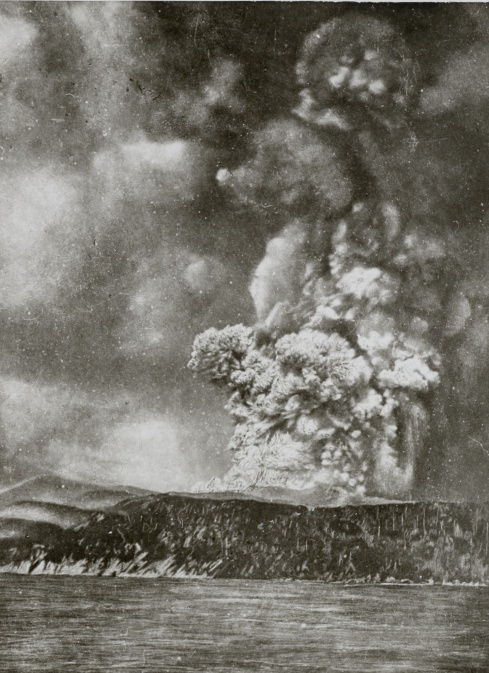
In 1883 a volcano on the island of Krakatoa exploded with the force of 13,000 Hiroshima bombs producing the loudest sound in recorded history. On the RMS Norham Castle 40 miles away from Krakatoa the captain wrote in his log that the eardrums of over half his crew were shattered. 3000 miles away on the Indian Ocean island of Rodrigues it was reported that the sound was still “like the distant roar of heavy guns”.vii Weather stations around the world recorded pressure changes on their barometers as the wave passed them. The wave circled the earth approximately every 34 hours from both directions. These waves went on for daysviii, but they did not go on forever.
Marconi was nine-years-old when this happened and so as a scientifically-curious person interested in wave propagation would have been well aware of it. If he knew such an unimaginably loud sound was undetectable after five days, then he could have no reason to suppose that a mere human voice could be detected by any conceivable means 2000 years later. More importantly, neither Greg Milner who put this extraordinary story in print nor Nate DiMeo who embellished it are able to cite any source for their claim that Marconi believed “no sound ever dies”.
-
i
Choate, Aden. “The Marconi Mythology.” The Provincetown Independent, December 27, 2023, https://provincetownindependent.org/history/2023/12/27/the-marconi-mythology/.
-
ii
Milner, Greg. Perfecting Sound Forever. An Aural History of Recorded Music. Farrar, Straus and Giroux, 2009
-
iii
DiMeo, Nate. “These Words, Forever.” The Memory Palace, June 1, 2009, https://thememorypalace.us/episode-12-these-words-forever/.
-
iv
Smulyan, Harold et al. “Wireless: The Life and Death of Guglielmo Marconi.” The American Journal of the Medical Sciences vol. 353,6 (2017): 511-515. doi:10.1016/j.amjms.2016.12.022
-
v
Lee, Paul, “The SS Birma's PV resurfaces at last”, https://www.paullee.com/titanic/Birma.php.
-
vi
Dam, H. J. W. “The New Telegraphy — An Interview with Signor Marconi.”, March 1897, https://www.fondazionemarconi.it/documenti/articoli/didattica/insegnanti/9.pdf.
-
vii
Judd, John Wesley, et al. The Eruption of Krakatoa: And Subsequent Phenomena. United Kingdom, Trübner & Company, 1888, p. 79, https://www.google.com/books/edition/The_Eruption_of_Krakatoa/Vk8PAAAAYAAJ.
-
viii
Judd, John Wesley, et al. The Eruption of Krakatoa: And Subsequent Phenomena. United Kingdom, Trübner & Company, 1888, pp. 57-78, https://www.google.com/books/edition/The_Eruption_of_Krakatoa/Vk8PAAAAYAAJ.